要旨
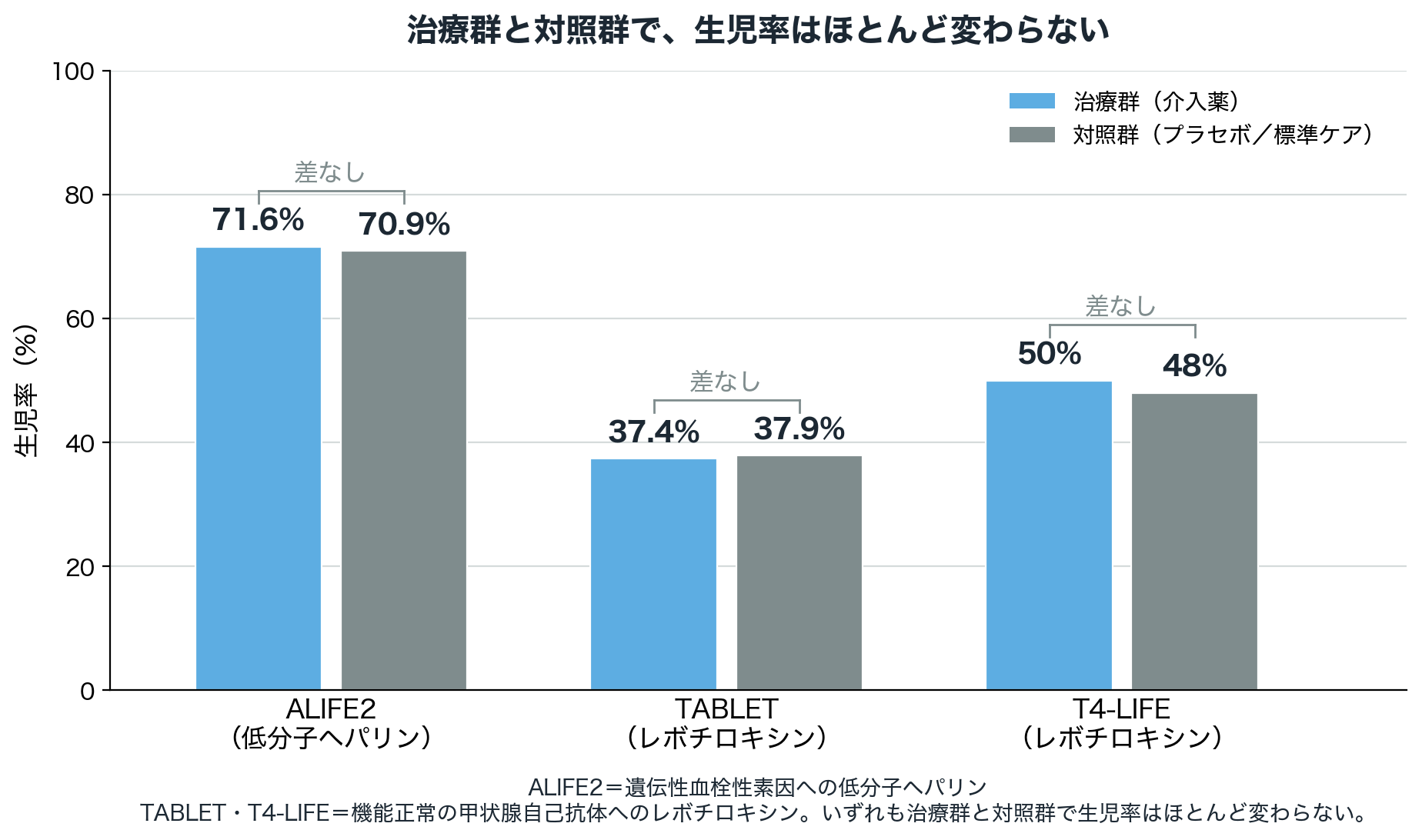
遺伝性の血栓性素因も、甲状腺機能が正常な甲状腺自己抗体陽性も、不育症の検査では「見つかる」。どちらも一見、治療できそうに見える――血栓素因には抗凝固を、甲状腺自己抗体にはレボチロキシンを足せばよい、と。だがランダム化比較試験はいずれも、生児が増えるという結果にはならなかった。血栓素因に低分子ヘパリンを上乗せしても生児率は変わらず(71.6%対70.9%、ALIFE2)、機能正常のTPO抗体陽性にレボチロキシンを投与しても変わらない(37.4%対37.9%、TABLET)。理由は機序にある。早期の流産の多くは血栓のイベントではなく、機能が正常なら補うべき欠乏もない。だから検査も同じ論理で絞られる。ただし、母体の静脈血栓塞栓症(VTE)の予防という別の確立した適応と、TSHが基準を超える本当の機能低下は、いずれも流産予防とは区別して扱う。
本論の要点
記事本文(数値解析・原典精読・国内実装の論点)は theLetter「産科の羅針盤」で全文無料で配信しています。本ページでは、論点の構造と図表アーカイブを公開しています。
本稿の要点
- 血栓素因と流産の関連は限定的(反復流産の女性の血栓素因頻度は一般集団と同等、Shehata 2022)。原因不明の反復流産では抗凝固はどれも生児を増やさない(de Jong 2014)。
- 専用RCTでも無効。血栓素因に的を絞ったALIFE2で、低分子ヘパリンは生児を増やさず(71.6%対70.9%)。後期喪失の既往者も高リスク素因も含めて差なし――早期流産の多くは血栓イベントではない。
- だからルーチン検査も勧めない(ESHRE 2018)。ただし抗凝固には母体VTE予防という別の確立適応があり、流産予防とは区別する(同じLMWHでも目的が違う)。
- 機能正常のTPO抗体陽性は流産・早産リスクを高める(Thangaratinam 2011)が、レボチロキシンでは生児は増えない(37.4%対37.9%、TABLET)。欠乏のないところに補っても、補う対象がない。
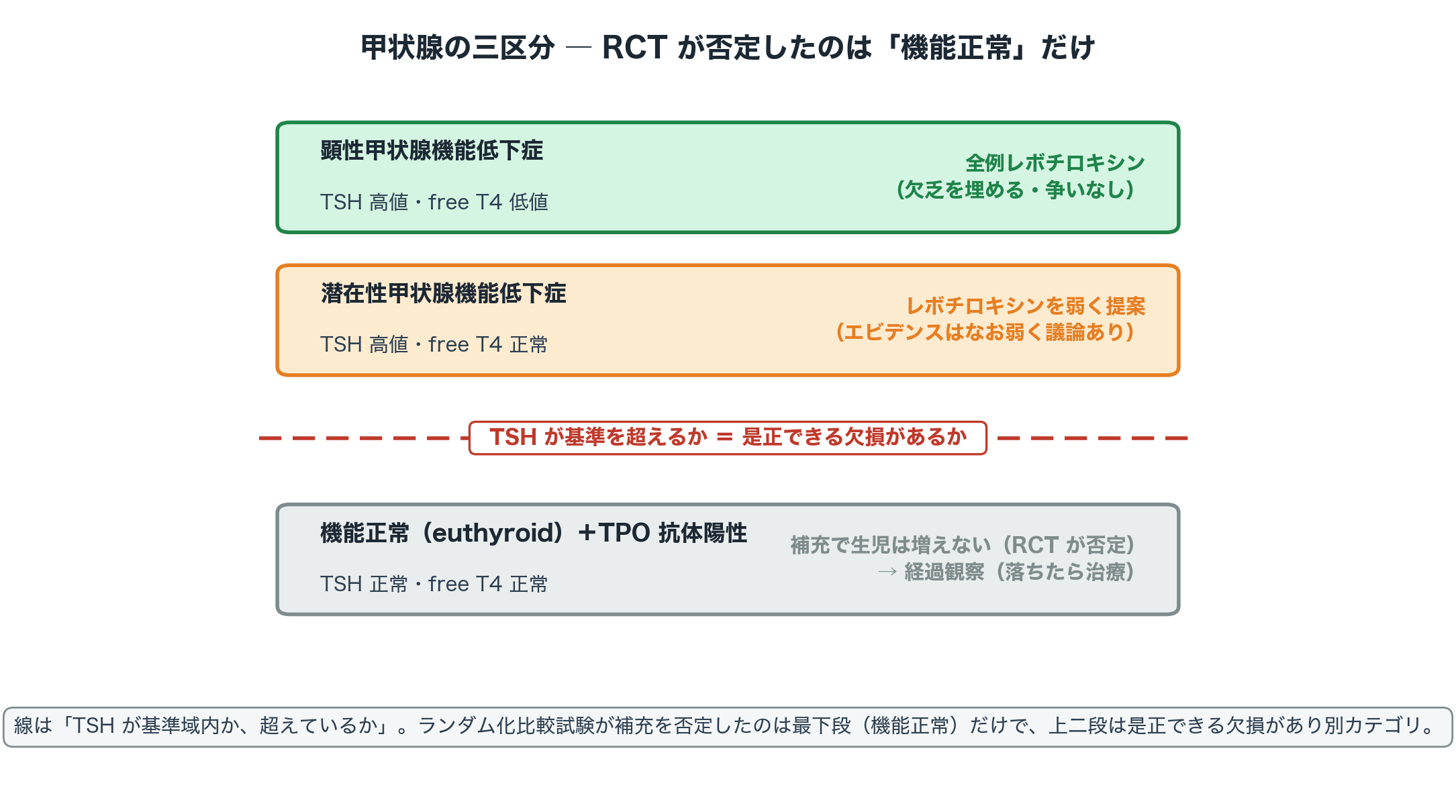
- 否定されたのは「機能正常への補充」だけ。TSHが基準を超える顕性・潜在性の機能低下は別カテゴリで治療対象。機能が正常なうちは補充せず、TSHを追う。
図表アーカイブ
主要参考文献
- Quenby S, et al. Heparin for women with recurrent miscarriage and inherited thrombophilia (ALIFE2): an international open-label, randomised controlled trial. Lancet 2023;402(10395):54-61. PMID 37271152. DOI 10.1016/S0140-6736(23)00693-1.
- de Jong PG, Kaandorp S, Di Nisio M, Goddijn M, Middeldorp S. Aspirin and/or heparin for women with unexplained recurrent miscarriage with or without inherited thrombophilia. Cochrane Database Syst Rev 2014;(7):CD004734. PMID 24995856. DOI 10.1002/14651858.CD004734.pub4.
- Dhillon-Smith RK, et al. Levothyroxine in Women with Thyroid Peroxidase Antibodies before Conception. N Engl J Med 2019;380(14):1316-1325. PMID 30907987. DOI 10.1056/NEJMoa1812537.
- van Dijk MM, et al. Levothyroxine in euthyroid thyroid peroxidase antibody positive women with recurrent pregnancy loss (T4LIFE trial): a multicentre, randomised, double-blind, placebo-controlled, phase 3 trial. Lancet Diabetes Endocrinol 2022;10(5):322-329. PMID 35298917. DOI 10.1016/S2213-8587(22)00045-6.
- Morita K, et al. Risk Factors and Outcomes of Recurrent Pregnancy Loss in Japan. J Obstet Gynaecol Res 2019;45(10):1997-2006. PMID 31397532. DOI 10.1111/jog.14083.
- Shehata H, et al. Thrombophilia screening in women with recurrent first trimester miscarriage: is it time to stop testing? — a cohort study and systematic review. BMJ Open 2022;12(7):e059519. PMID 35831047. DOI 10.1136/bmjopen-2021-059519.
- Thangaratinam S, et al. Association between thyroid autoantibodies and miscarriage and preterm birth: meta-analysis of evidence. BMJ 2011;342:d2616. PMID 21558126. DOI 10.1136/bmj.d2616.
- Nazarpour S, et al. Effects of Levothyroxine on Pregnant Women With Subclinical Hypothyroidism, Negative for Thyroid Peroxidase Antibodies. J Clin Endocrinol Metab 2018;103(3):926-935. PMID 29126290. DOI 10.1210/jc.2017-01850.
- ESHRE Guideline Group on RPL. ESHRE guideline: recurrent pregnancy loss (2018) / an update in 2022. Hum Reprod Open 2018;2018(2):hoy004(PMID 31486805); 2023;2023(1):hoad002(PMID 36873081).
- 日本産科婦人科学会/日本生殖医学会ほか. 不育症管理に関する提言 2025(こども家庭庁 研究班).
- Korevaar TIM, et al. American Thyroid Association 2026 Guidelines for Thyroid Disease in Preconception, Pregnancy, and Postpartum. Thyroid 2026;36(5):481-544. PMID 42219800. DOI 10.1177/10507256261445624.
- American College of Obstetricians and Gynecologists. Thyroid Disease in Pregnancy. ACOG Practice Bulletin No. 223. Obstet Gynecol 2020;135(6):e261-e274. PMID 32443080.