要旨
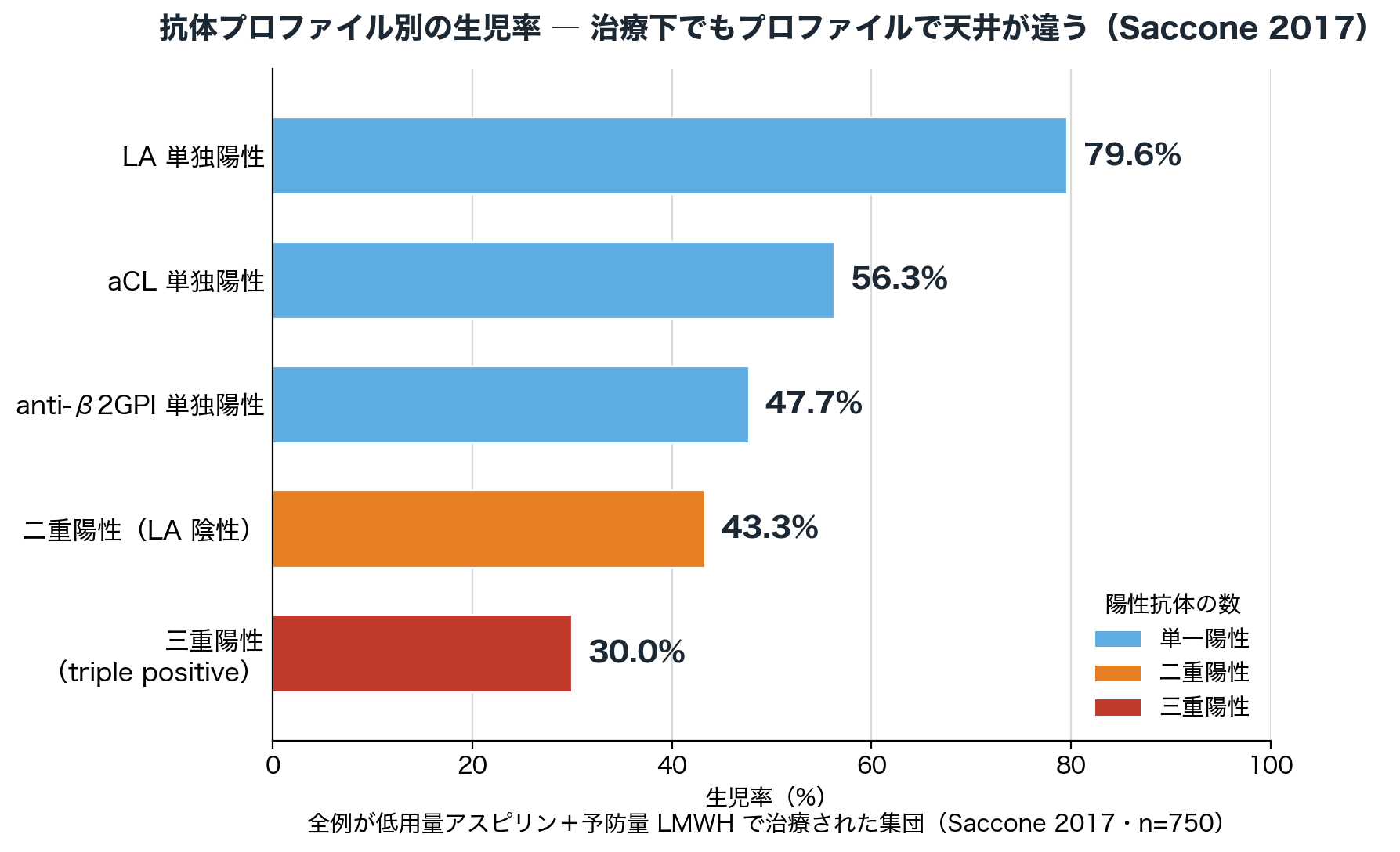
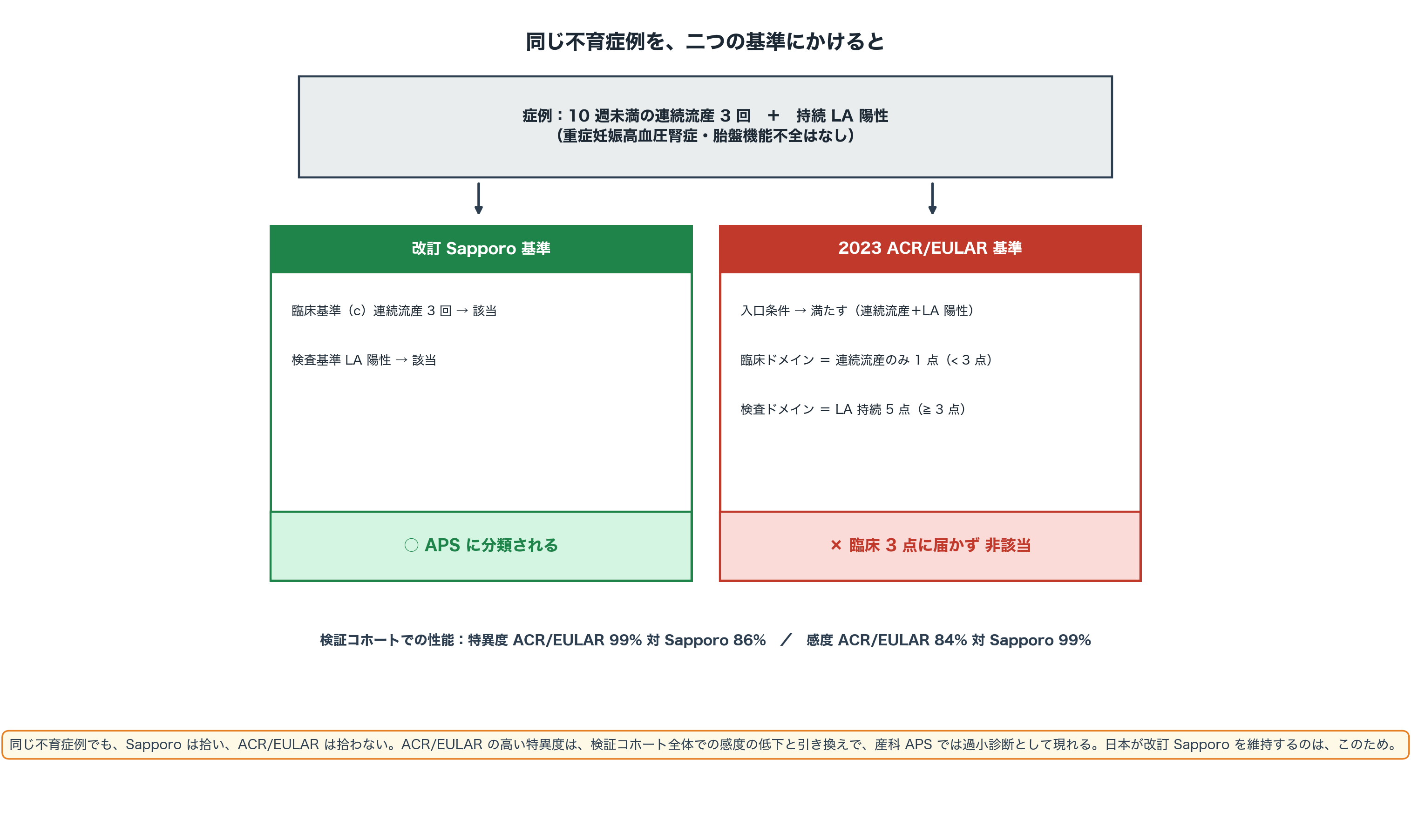
産科APSの治療を決めるのは「APS」という診断名ではなく、抗体プロファイル――どの抗体が、どれだけの量で、持続して陽性か、だ。三つの抗体がすべて陽性(triple-positive)なら、低用量アスピリンと予防量ヘパリンで治療してもなお生児は約3割にとどまり、なかでもループスアンチコアグラント(LA)が最も重い予測因子である(LA陽性の有害妊娠転帰39%に対し、陰性は3%)。一方で、分類基準は診断基準ではない。満たさないことはAPSの否定にならず、特異度を優先する2023年ACR/EULAR基準は産科APSを過小診断しうる――だから日本は改訂Sapporo基準を維持する。確立した治療は低用量アスピリン+ヘパリンだけで、過剰治療は決まってその確立範囲の外側、再検で消える偶発的なaPLへの上乗せで起こる。そして約2割は治療下でも届かず、確立した二次治療はない。
本論の要点
記事本文(数値解析・原典精読・国内実装の論点)は theLetter「産科の羅針盤」で全文無料で配信しています。本ページでは、論点の構造と図表アーカイブを公開しています。
本稿の要点
- 予後を決めるのは診断名でなく抗体プロファイル(数・種類・力価・持続)。陽性抗体が多いほど予後は悪く、triple-positiveは治療下でも生児30%(Saccone 2017/PREGNANTS)。
- LAが最も重い予測因子。LA陽性の39%が有害妊娠転帰、LA陰性は3%(Lockshin 2012/PROMISSE)。aCL・anti-β2GPI単独はLAを伴わなければ転帰を予測しない。
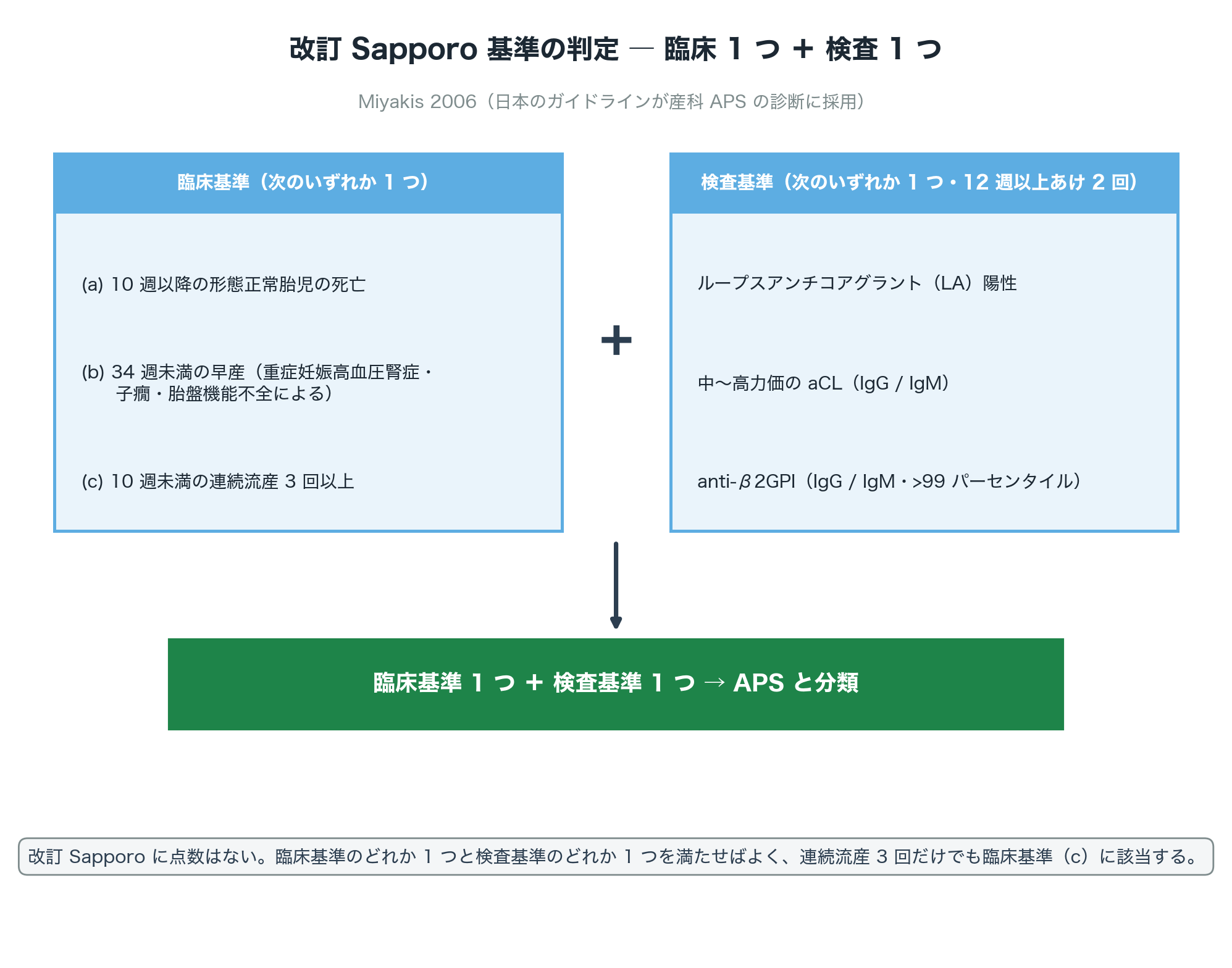
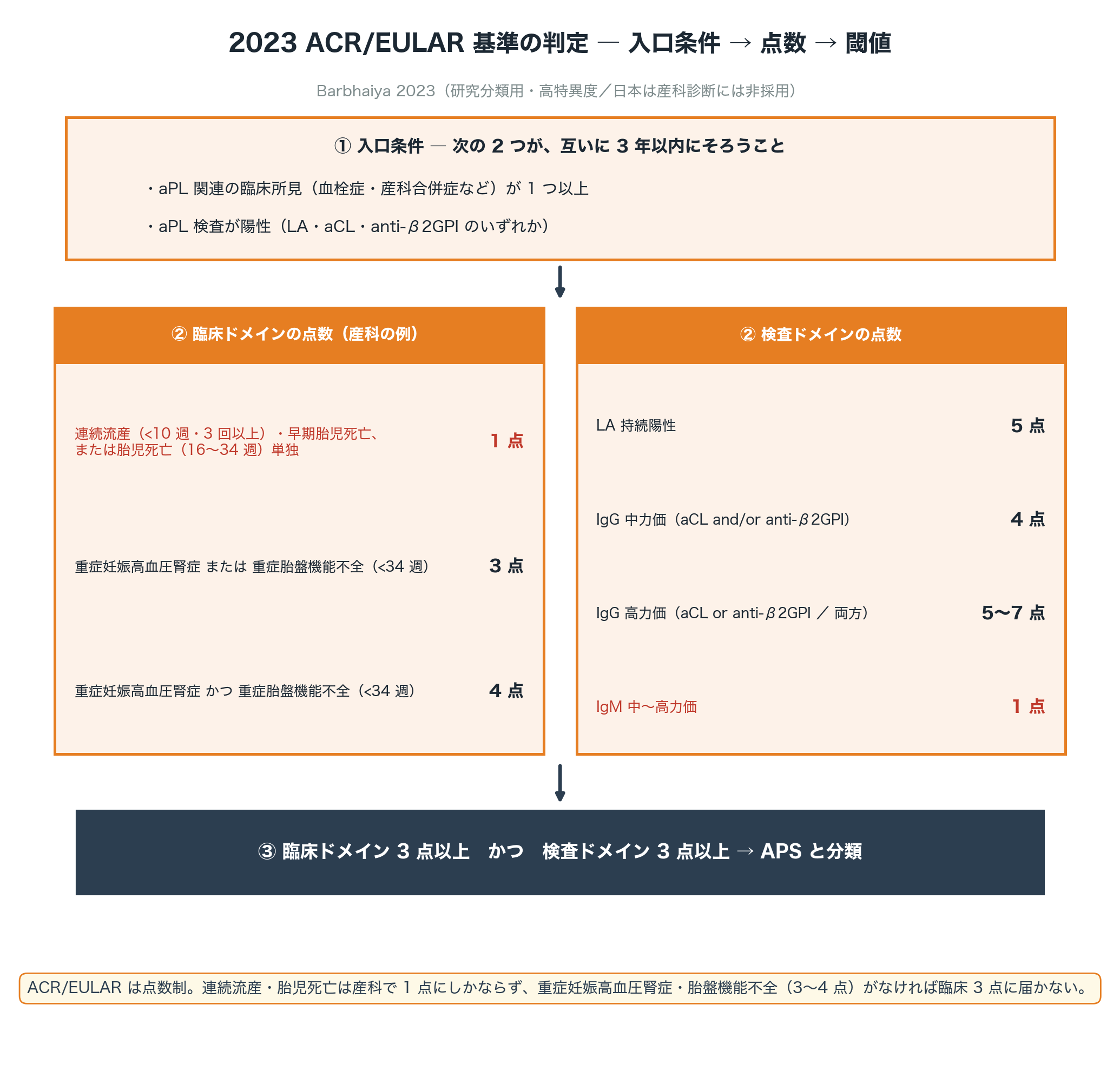
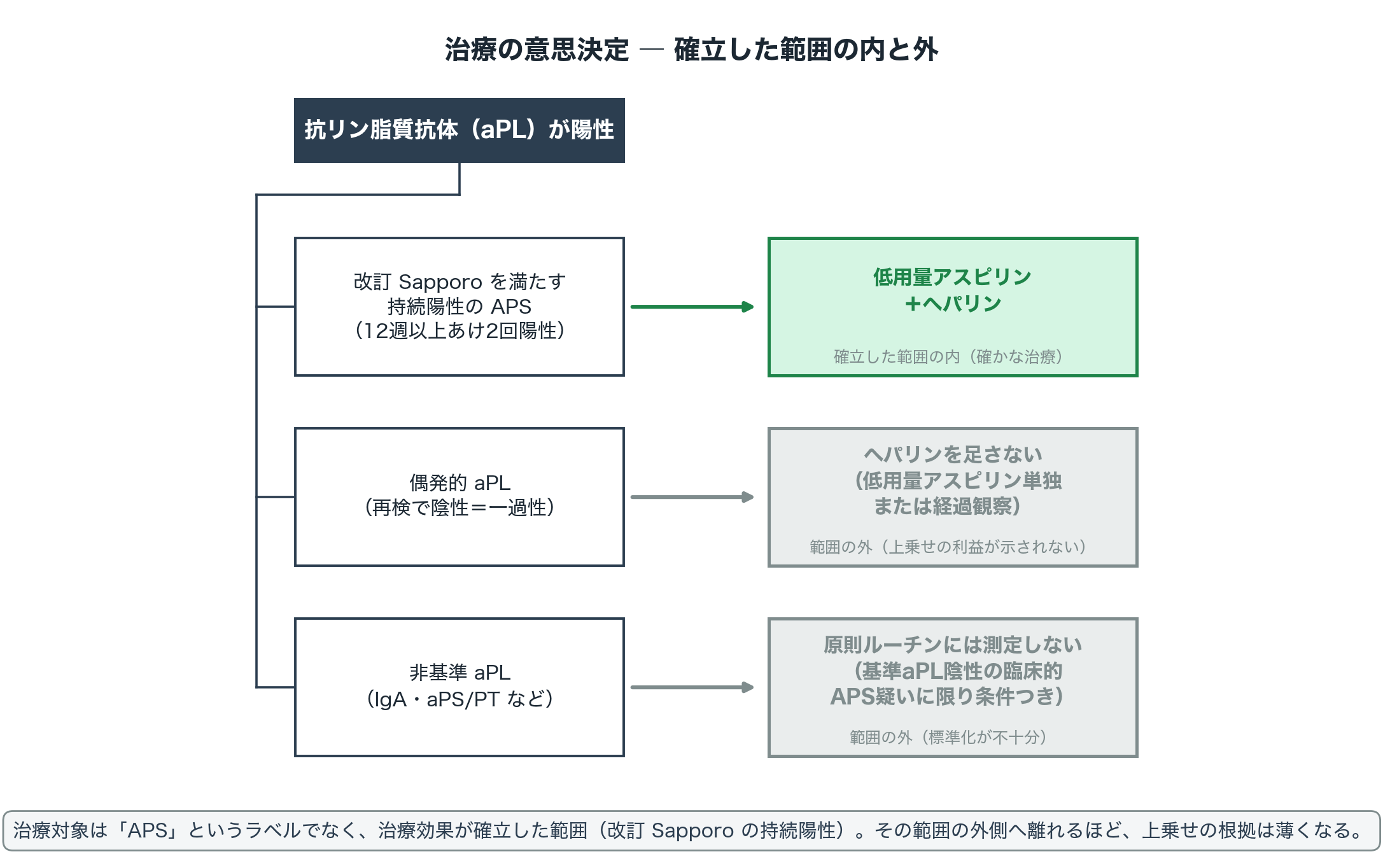
- 分類基準は診断基準ではない。満たさないことはAPS否定でない。2023 ACR/EULARは特異度99%(改訂Sapporo 86%)で産科APSを過小診断しうるため、日本は改訂Sapporoを維持。
- 過剰治療は確立範囲の外で起こる。再検で消える偶発的aPLへのヘパリン上乗せは生児を増やさない(Morita 2019:低用量アスピリン単独81.8%に対し併用76.0%)。
- 確立治療は低用量アスピリン+ヘパリン(国際はLMWH、日本は保険でUFH)。約2割は難治で、確立した二次治療はない(次の一手は抗炎症・免疫・補体だが確証前)。
図表アーカイブ
主要参考文献
- Saccone G, et al. Antiphospholipid antibody profile based obstetric outcomes of primary antiphospholipid syndrome: the PREGNANTS study. Am J Obstet Gynecol 2017;216(5):525.e1-525.e12. PMID 28153662. DOI 10.1016/j.ajog.2017.01.026.
- Lockshin MD, et al. Prediction of adverse pregnancy outcome by the presence of lupus anticoagulant, but not anticardiolipin antibody, in patients with antiphospholipid antibodies. Arthritis Rheum 2012;64(7):2311-2318. PMID 22275304. DOI 10.1002/art.34402.
- Galli M, Luciani D, Bertolini G, Barbui T. Lupus anticoagulants are stronger risk factors for thrombosis than anticardiolipin antibodies in the antiphospholipid syndrome: a systematic review of the literature. Blood 2003;101(5):1827-1832. PMID 12393574. DOI 10.1182/blood-2002-02-0441.
- Nonobe M, et al. Prognostic Value of Lupus Anticoagulant and Anti-β2 Glycoprotein I Antibody in Adverse Pregnancy Outcomes. Arthritis Rheumatol 2026;78(2):371-384. PMID 40755140. DOI 10.1002/art.43341.
- Miyakis S, et al. International consensus statement on an update of the classification criteria for definite antiphospholipid syndrome (APS). J Thromb Haemost 2006;4(2):295-306. PMID 16420554. DOI 10.1111/j.1538-7836.2006.01753.x.
- Barbhaiya M, et al. 2023 ACR/EULAR antiphospholipid syndrome classification criteria. Ann Rheum Dis 2023;82(10):1258-1270. PMID 37640450. DOI 10.1136/ard-2023-224609.
- Vila P, et al. Prevalence, follow-up and clinical significance of the anticardiolipin antibodies in normal subjects. Thromb Haemost 1994;72(2):209-213. PMID 7831653.
- Morita K, et al. Risk Factors and Outcomes of Recurrent Pregnancy Loss in Japan. J Obstet Gynaecol Res 2019;45(10):1997-2006. PMID 31397532. DOI 10.1111/jog.14083.
- Hamulyák EN, et al. Aspirin or heparin or both for improving pregnancy outcomes in women with persistent antiphospholipid antibodies and recurrent pregnancy loss. Cochrane Database Syst Rev 2020;5(5):CD012852. PMID 32358837. DOI 10.1002/14651858.CD012852.pub2.
- Naimi AI, et al. The Effect of Preconception-Initiated Low-Dose Aspirin on Human Chorionic Gonadotropin-Detected Pregnancy, Pregnancy Loss, and Live Birth: Per Protocol Analysis of a Randomized Trial. Ann Intern Med 2021;174(5):595-601. PMID 33493011. DOI 10.7326/M20-0469.
- Branch DW, et al. Certolizumab pegol to prevent adverse pregnancy outcomes in patients with antiphospholipid syndrome and lupus anticoagulant (IMPACT): results of a prospective, single-arm, open-label, phase 2 trial. Ann Rheum Dis 2025;84(6):1011-1022. PMID 40483169. DOI 10.1016/j.ard.2025.02.012.
- Ruffatti A, et al. Effect of Additional Treatments Combined with Conventional Therapies in Pregnant Patients with High-Risk Antiphospholipid Syndrome: A Multicentre Study. Thromb Haemost 2018;118(4):639-646. PMID 29490410. DOI 10.1055/s-0038-1632388.
- Kaneko K, et al. Intravenous immunoglobulin treatment for obstetric antiphospholipid syndrome refractory to conventional therapy: a single-arm, open-labelled multicentre clinical trial. Mod Rheumatol 2024;34(3):515-522. PMID 37340865. DOI 10.1093/mr/road062.
- Lefkou E, et al. Pravastatin improves pregnancy outcomes in obstetric antiphospholipid syndrome refractory to antithrombotic therapy. J Clin Invest 2016;126(8):2933-2940. PMID 27454295. DOI 10.1172/JCI86957.
- Rovere-Querini P, et al. Eculizumab in a pregnant patient with laboratory onset of catastrophic antiphospholipid syndrome: A case report. Medicine (Baltimore) 2018;97(40):e12584. PMID 30290624. DOI 10.1097/MD.0000000000012584.
- Sammaritano LR, et al. 2020 American College of Rheumatology Guideline for the Management of Reproductive Health in Rheumatic and Musculoskeletal Diseases. Arthritis Rheumatol 2020;72(4):529-556. PMID 32090480. DOI 10.1002/art.41191.
- 「抗リン脂質抗体陽性妊娠の診療ガイドライン2026」(南山堂)
- 日本産科婦人科学会・日本産婦人科医会「産婦人科診療ガイドライン産科編2026」