要旨
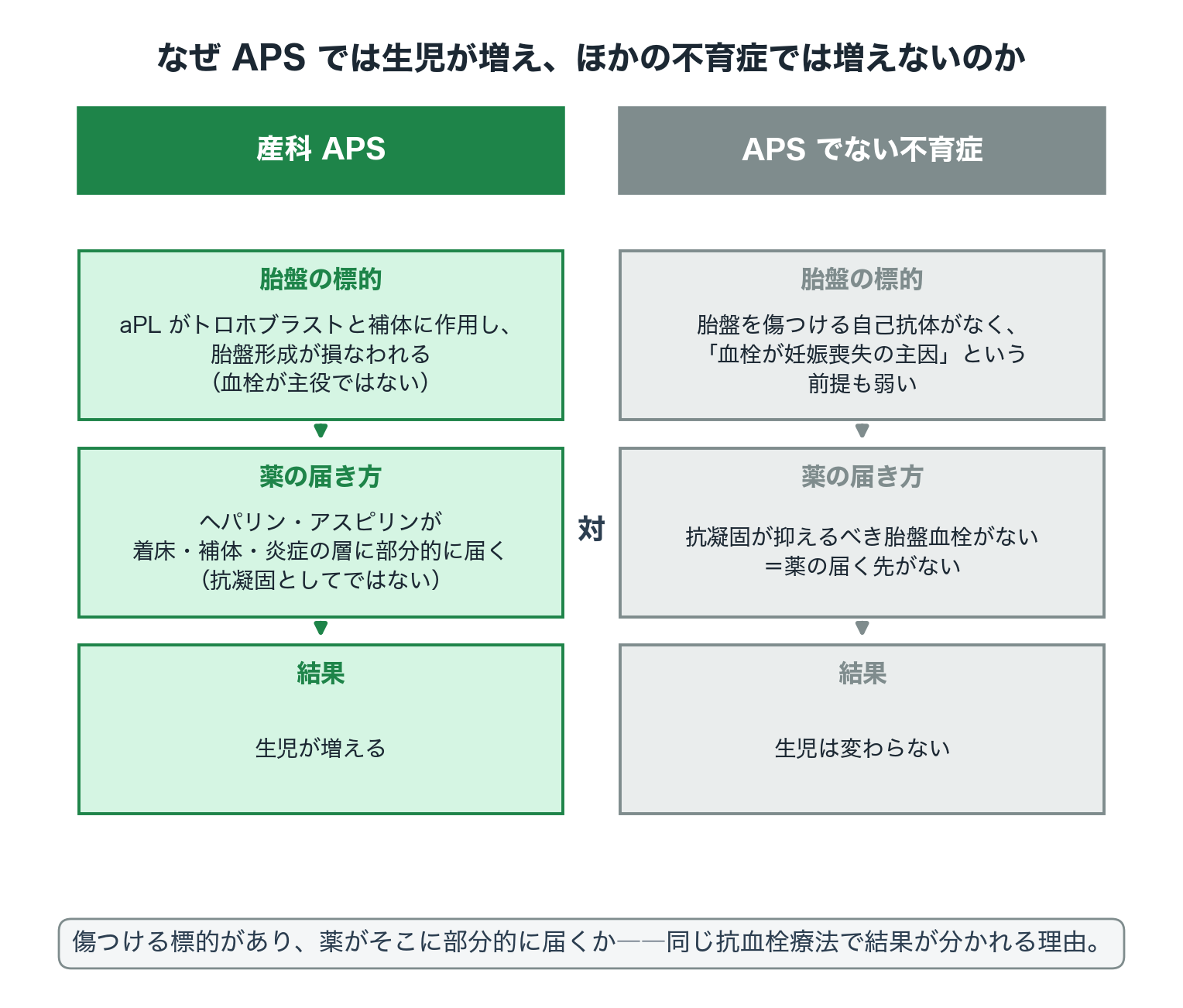
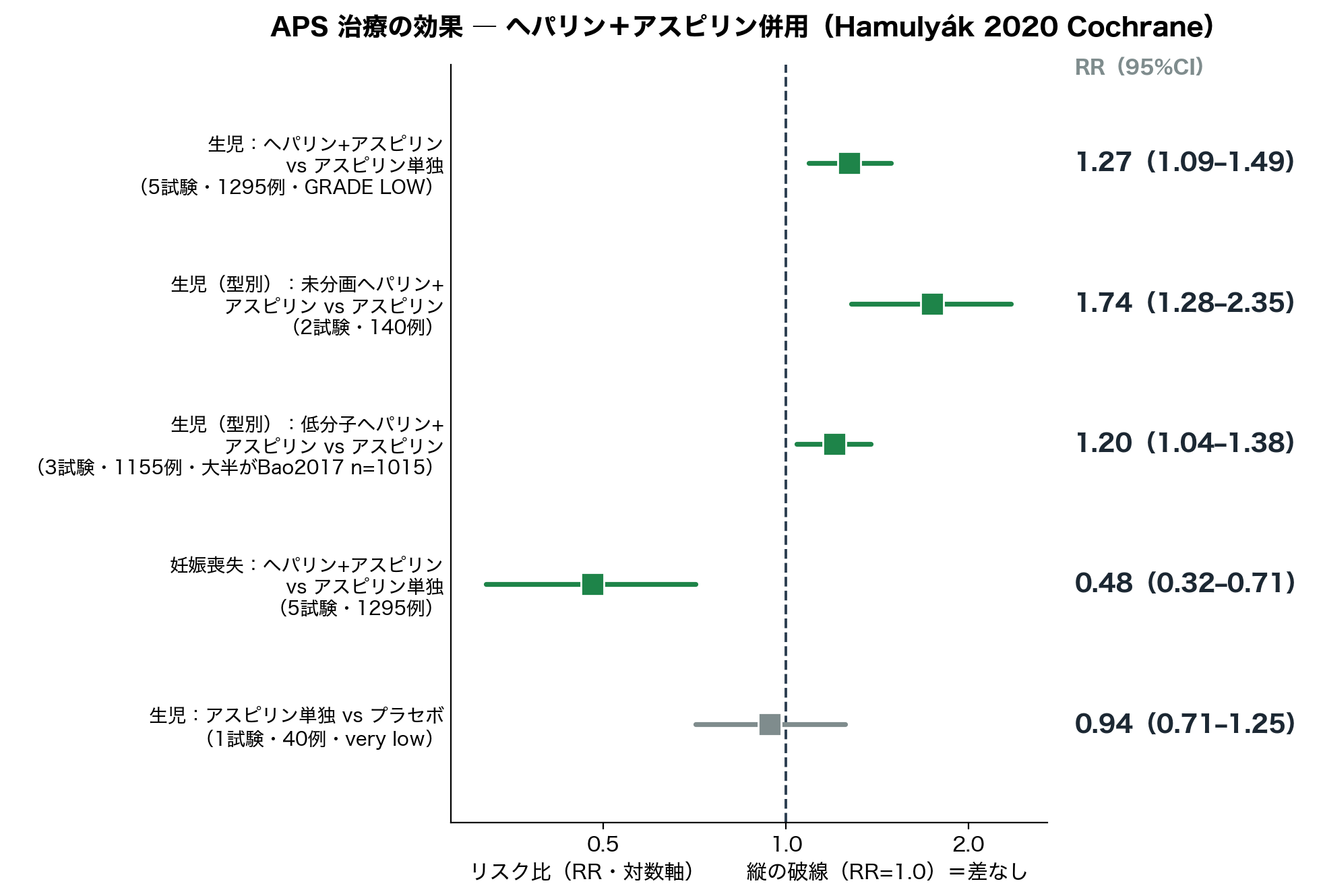
不育症の精査で見つかる所見のうち、治療で生児が増えると臨床試験で示された原因は、実質的に抗リン脂質抗体症候群(APS)だけである。低用量アスピリンとヘパリンの併用で、流産という代理指標だけでなく、生児という結果そのものが増える。だが第2回が描くのは、その効果の「正体」と「限界」だ。生児を増やしている主体は「血を固まりにくくすること」ではない――産科APSの妊娠喪失は胎盤の血栓ではなく、抗リン脂質抗体によるトロホブラスト(栄養膜細胞)の障害と補体の活性化が主体で、ヘパリンはむしろ抗炎症的に働く。しかも「増える」を裏づけるエビデンスは強くない。確実性はGRADEでLOW、推定はほぼ単一の大規模試験(Bao 2017)に依存する。射程も限られ、早産や胎児発育不全(FGR)は減らせず、約2割は治療下でも届かない。
本論の要点
記事本文(数値解析・原典精読・国内実装の論点)は theLetter「産科の羅針盤」で全文無料で配信しています。本ページでは、論点の構造と図表アーカイブを公開しています。
本稿の要点
- APSは「治療で生児が増える」と無作為化試験で示された実質的に唯一の所見。多くの随伴所見は無治療でも予後が良い。ただし「なぜ増えるか」は別問題。
- 効くのは抗凝固作用ではない。主役は胎盤血栓でなく、aPLによるトロホブラスト障害と補体活性化。ヘパリンも「結合の遮断・トロホブラスト保護・補体抑制」という非抗凝固作用で効く(「確立」でなく「示唆」の水準)。
- 生児は増える(RR 1.27)が確実性はGRADE LOW。試験の偏りとヘパリン種別の効果量のばらつきが理由で、推定の大部分は単一試験(Bao 2017)に依存。アスピリン単独では増えず、効くのは併用。
- ヘパリンの作用は二次的で、しばしば不十分。約2割(高リスクはさらに:PROMISSEでLAC陽性39%/PREGNANTSでtriple-positive 生児30%)が難治。早産・FGRは減らせない。難治例の次の一手は抗凝固でなく抗炎症・補体(HCQ・補体阻害・プラバスタチン)だが、いずれも確証前。
図表アーカイブ
主要参考文献
- Hamulyák EN, Scheres LJJ, Marijnen MC, et al. Aspirin or heparin or both for improving pregnancy outcomes in women with persistent antiphospholipid antibodies and recurrent pregnancy loss. Cochrane Database Syst Rev 2020;5:CD012852. PMID 32358837.
- Bor B, et al. Therapeutic Interventions for Obstetric Antiphospholipid Syndrome Associated with Recurrent Pregnancy Loss: A Scoping Review of RCTs on Live Birth Outcomes. Semin Thromb Hemost 2026. PMID 42086193. DOI 10.1055/a-2866-2950.
- Bao SH, et al. Use of D-dimer measurement to guide anticoagulant treatment in recurrent pregnancy loss associated with antiphospholipid syndrome. Am J Reprod Immunol 2017. PMID 29024233.
- Miyakis S, et al. International consensus statement on an update of the classification criteria for definite antiphospholipid syndrome (APS). J Thromb Haemost 2006;4(2):295-306. PMID 16420554. DOI 10.1111/j.1538-7836.2006.01753.x.
- McNeil HP, Simpson RJ, Chesterman CN, Krilis SA. Anti-phospholipid antibodies are directed against a complex antigen that includes a lipid-binding inhibitor of coagulation: beta 2-glycoprotein I (apolipoprotein H). Proc Natl Acad Sci U S A 1990;87(11):4120-4124. PMID 2349221.
- Viall CA, Chamley LW. Histopathology in the placentae of women with antiphospholipid antibodies: a systematic review of the literature. Autoimmun Rev 2015;14(5):446-471. PMID 25620498.
- Tong M, Viall CA, Chamley LW. Antiphospholipid antibodies and the placenta: a systematic review of their in vitro effects and modulation by treatment. Hum Reprod Update 2015;21(1):97-118. PMID 25228006.
- Meroni PL, et al. Can we cure antiphospholipid syndrome? Curr Opin Immunol 2025;96:102610. PMID 40768877.
- de Jesús GR, et al. 16th International Congress on Antiphospholipid Antibodies Task Force Report on Obstetric Antiphospholipid Syndrome. Lupus 2020;29(12):1601-1615. PMID 32883160.
- D'Ippolito S, et al. Antiphospholipid syndrome in pregnancy: new and old pathogenetic mechanisms. Int J Mol Sci 2023;24(4):3195. PMID 36834614. DOI 10.3390/ijms24043195.
- Branch DW, Lim MY. How I diagnose and treat antiphospholipid syndrome in pregnancy. Blood 2024;143(9):757-768. PMID 38145574.
- Hooper A, Bacal V, Bedaiwy MA. Does adding hydroxychloroquine to empiric treatment improve the live birth rate in refractory obstetrical antiphospholipid syndrome? A systematic review. Am J Reprod Immunol 2023;90(3):e13761. PMID 37641373. DOI 10.1111/aji.13761.
- Holers VM, Girardi G, et al. Complement C3 activation is required for antiphospholipid antibody-induced fetal loss. J Exp Med 2002;195:211-220. PMID 11805148.
- Girardi G, et al. Complement C5a receptors and neutrophils mediate fetal injury in the antiphospholipid syndrome. J Clin Invest 2003;112(11):1644-1654. PMID 14660741.
- Girardi G, Redecha P, Salmon JE. Heparin prevents antiphospholipid antibody-induced fetal loss by inhibiting complement activation. Nat Med 2004;10(11):1222-1226. PMID 15489858.
- Kim MY, et al. Complement activation predicts adverse pregnancy outcome in patients with systemic lupus erythematosus and/or antiphospholipid antibodies. Ann Rheum Dis 2018;77(4):549-555. PMID 29371202.
- Carroll TY, et al. Modulation of trophoblast angiogenic factor secretion by antiphospholipid antibodies is not reversed by heparin. Am J Reprod Immunol 2011. PMID 21545366.
- Cochery-Nouvellon É, et al. Obstetric antiphospholipid syndrome: early variations of angiogenic factors are associated with adverse outcomes. Haematologica 2017;102(5):835-842. PMID 28126966.
- Tanimura K, et al. The β2-glycoprotein I/HLA-DR complex as a major autoantibody target in obstetric antiphospholipid syndrome. Arthritis Rheumatol 2020;72(11):1882-1891. PMID 32583563.
- Tanimura K, Jin H, et al. β2-glycoprotein I/HLA class II complexes are novel autoantigens in antiphospholipid syndrome. Blood 2015;125(18):2835-2844. PMID 25733579.
- Shehata H, et al. Thrombophilia screening in women with recurrent first trimester miscarriage: is it time to stop testing? A cohort study and systematic review of the literature. BMJ Open 2022;12(7):e059519. PMID 35831047.
- de Jong PG, Kaandorp S, Di Nisio M, Goddijn M, Middeldorp S. Aspirin and/or heparin for women with unexplained recurrent miscarriage with or without inherited thrombophilia. Cochrane Database Syst Rev 2014;(7):CD004734. PMID 24995856.
- Quenby S, et al. Heparin for women with recurrent miscarriage and inherited thrombophilia (ALIFE2): an international open-label, randomised controlled trial. Lancet 2023;402(10395):54-61. PMID 37271152.
- Bender Atik R, Christiansen OB, et al. ESHRE guideline: recurrent pregnancy loss. Hum Reprod Open 2018;2018(2):hoy004. PMID 31486805. DOI 10.1093/hropen/hoy004.
- 「抗リン脂質抗体陽性妊娠の診療ガイドライン2026」(南山堂)
- こども家庭庁「不育症管理に関する提言(2025)」